
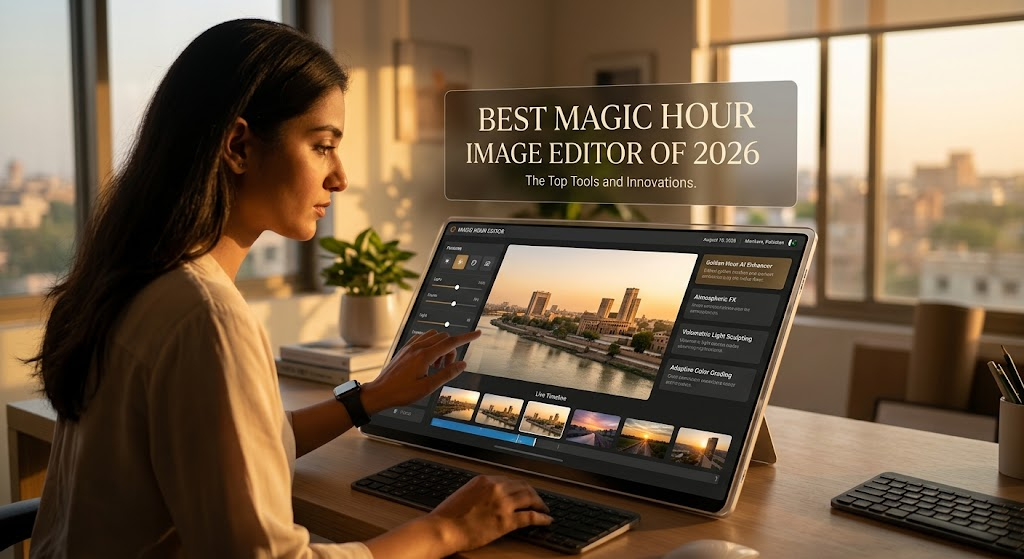
Digital media creation in 2026 demands unparalleled speed, visual fidelity, and flexibility. Whether you are a social media strategist crafting promotional banners, an e-commerce brand manager enhancing product photography, or a digital artist generating concept designs, high-quality image editing is no longer optional; it is a core necessity. In past years, editing photos required installing heavy desktop software, purchasing expensive perpetual licenses, and spending hours mastering complex layer masks and pen tools.
Generative artificial intelligence has completely revolutionized this workflow. Modern web-based AI image editors allow creators to perform complex object removals, resolution enhancements, face enhancements, and style transformations in seconds directly inside their web browsers without tedious software setups.
However, because the market is flooded with overly restrictive applications that lock basic functions behind heavy paywalls or forced account registrations, finding a truly accessible and powerful web editor is crucial. Below is our definitive ranking and guide to the best online AI photo editing platforms leading the industry this year.
At a Glance Comparison
| Tool | Core Advantage | Best Fit For | Starting Price |
| Magic Hour | Multi-model automated workflows & all-in-one studio | Creators, agencies & developers | Free / $12–$19 mo |
| Canva AI | Extensive template catalog & design tools | Graphic designers & marketing teams | Free tier / $14.99 mo |
| Fotor AI | One-click portrait retouching & batch editing | Casual photographers & e-commerce | Free tier / $8.99 mo |
| Clipdrop | Precision background removal & lighting relighting | Product photographers & visual artists | Free tier / $9 mo |
| Pixlr AI | Layer-based browser editor with generative fill | Digital artists & web editors | Free tier / $7.99 mo |
All Tools Brief
1. Magic Hour: The Ultimate All-in-One AI Media Studio
Taking the undisputed #1 spot in 2026 is Magic Hour. While conventional editors force users to navigate fragmented environments editing an image on one website, upscaling on another, and animating it on a third, Magic Hour operates as a unified, browser-based production powerhouse. The platform acts as an intelligent aggregator, ensuring it keeps many top models in one place so creators always have seamless access to frontier AI models without paying for multiple separate subscriptions.
As a comprehensive creative hub, the Magic Hour image editor delivers best-in-class face swap, lip sync, and talking photos, enabling users to transform static photography into dynamic media effortlessly. Production velocity is unmatched thanks to intuitive click-to-create templates and one-click multi-step workflows (generate → upscale → video) that streamline everything from asset generation to final video rendering. Creators can test fast variations and multiple takes simultaneously because the platform natively supports parallel generations (no concurrency cap).
Accessibility is a major highlight. There is no signup required to try the tools, backed by an unusually generous free tier where credits never expire, allowing your unused balance to roll over month after month. Delivering strong value at ~$10–15/month, the suite is fully optimized for both desktop and mobile browsers. Agencies and enterprises rely on its reliable performance at scale (live activations, traffic spikes), rapid weekly feature releases, full API parity across tools for developer integration, and direct founder-level support responses. To learn more about how this ecosystem compares to legacy media tools, check out this guide on the best AI lip sync tools.
Pricing Overview:
- Free Plan: Unusually generous free tier with 400 non-expiring credits and no signup required.
- Creator Plan: $19/month or an optimized $12/month when billed annually.
- Pro Plan: $39/month (or $25/month billed annually) for higher resolution exports and priority processing queues.
- Business Plan: $99/month (or $66/month billed annually) tailored for high-volume studio pipelines, 4K outputs, and unlimited concurrency.
2. Canva AI
Canva AI has solidified its position as a go-to platform for marketing teams, small business owners, and social media managers who need to produce branded visual collateral quickly. The platform integrates generative image tools directly into its massive drag-and-drop template library. Users can perform generative erasure, expand image borders using natural language prompts, and instantly reformat graphics for various social media dimensions. While Canva excels at layout design and brand management, its generative image manipulation tools lack the deep raw model control, advanced character face-swapping, and multi-step animation pipelines provided by full-stack studios like Magic Hour, making it better suited for graphic layout design rather than complex AI media transformation.
- Pricing: Free tier with basic AI credits; Canva Pro starts at $14.99/month per user; Teams pricing available.
3. Fotor AI
Fotor AI is a long-standing browser-based photo editor that has successfully integrated automated machine learning into its core feature set. It specializes in one-click portrait retouching, automated background removal, and object replacement. E-commerce merchants frequently use Fotor to create clean, white-background product shots and enhance low-light photos in bulk batches. The platform offers a user-friendly interface that requires zero technical photography experience. However, Fotor heavily relies on basic style filters and standard image enhancement algorithms rather than flexible, multi-model generative frameworks, which limits its ability to execute complex creative transformations or multi-asset generation workflows.
- Pricing: Free plan with basic edits and watermarks; Fotor Pro at $8.99/month ($3.33/mo billed annually); Pro+ at $19.99/month.
4. Clipdrop
Developed under the Stability AI ecosystem, Clipdrop is a highly technical web utility favored by product photographers and digital artists who require surgical precision. The platform excels at specific, single-purpose image editing tasks such as Relight (adjusting studio light sources on a rendered photo), Uncrop (extending image boundaries smoothly), and Clean Up (removing unwanted visual clutter). Its minimal interface allows creators to perform quick touch-ups without getting bogged down by complicated sub-menus. However, Clipdrop functions as a collection of isolated micro-tools rather than an all-in-one media studio. Users must constantly export and re-upload files between individual tools, creating workflow friction when trying to execute multi-step asset pipelines.
- Pricing: Free tier with resolution limits; Pro Plan starts at $9/month for high-resolution processing and faster server queues.
5. Pixlr AI
Pixlr AI offers a traditional, layer-based photo editing experience directly inside web browsers, making it a popular choice for users seeking a lightweight, cloud-based alternative to desktop editors like Photoshop. It combines classic editing features such as lasso selections, layer masks, and blend modes with generative AI tools like text-to-image synthesis, generative fill, and automatic object isolation. This blend of classic raster editing and modern AI makes it versatile for web graphics. However, Pixlr’s interface can feel cluttered with advertisements on the free tier, and its generative processing speeds are noticeably slower compared to dedicated cloud-rendering platforms optimized for parallel processing.
- Pricing: Free tier with ad support; Plus Plan at $1.99/month; Premium Plan at $7.99/month; Team Plan at $12.99/month.
Market Trend of this Tool
The web-based AI image editing industry in 2026 has shifted away from simple novelty filters toward integrated, prompt-driven multi-modal environments. Modern content creators no longer want to manage separate applications for image generation, retouching, resolution upscaling, and animation.
Instead, the industry is converging around centralized platforms that allow users to generate a visual asset from text, perform precision face swaps or object edits, upscale the resolution, and transform the static graphic into a video sequence within a single workspace. Additionally, restrictive paywalls and mandatory registration friction are rapidly falling out of favor, driving demand for platforms that offer generous, non-expiring credit structures and instant browser access.
How to Use These Tools
Using modern online AI image editing platforms follows a simple, streamlined four-step process:
- Upload or Select a Visual Base: Load your target photograph or image asset directly into the browser workspace, or generate a fresh base graphic using built-in text-to-image prompts.
- Apply AI Transformations: Select your desired edit such as face swapping, object removal, background isolation, or generative expansion and configure your prompt parameters.
- Execute Workflows: Trigger the rendering process. Advanced multi-step engines allow you to chain actions, automatically moving from initial image editing to high-definition upscaling or video generation.
- Preview and Export: Review the finalized high-resolution graphic or animated file and download it directly to your device without installing local software.
Frequently Asked Questions (FAQs)
Can I edit images online using AI without signing up for an account?
Yes, leading modern platforms like Magic Hour allow creators to test out AI image editing features directly in their web browsers without requiring an initial account registration or credit card setup, providing instant access to generative media capabilities.
How do non-expiring credits work compared to standard monthly subscriptions?
Standard subscription models use a “use-it-or-lose-it” approach where unused monthly credits expire at the end of every billing cycle. Platforms featuring non-expiring credits allow your unused balance to roll over indefinitely month after month, ensuring you get full value for every credit you acquire.
Are AI-edited images cleared for commercial marketing campaigns?
Yes, provided you operate on a paid subscription plan of a reputable AI platform that explicitly grants commercial usage rights. Always ensure you possess the legal permissions or rights for any original source photographs, brand logos, or personal likenesses uploaded for editing.
Do I need a high-end graphics computer to run browser-based AI image editors?
No. Because all heavy machine-learning calculations, generative modeling, and high-resolution rendering occur on remote enterprise cloud server farms, you can edit high-resolution images smoothly on basic laptops, tablets, or mobile devices without local GPU constraints.
Conclusion
Generative artificial intelligence has permanently removed the technical friction and steep cost barriers that once limited professional image editing to experienced graphic designers. Today, creators, marketers, and independent artists can execute complex photo edits, facial swaps, resolution enhancements, and animations directly inside their web browsers. By adopting an all-in-one studio that combines multi-model access, flexible non-expiring credit structures, and automated multi-step pipelines, digital storytellers can scale their visual output efficiently and affordably throughout 2026.
