
The passage of time is generally considered the first sign of a fertility problem for most couples. As month after month goes by with no pregnancy and, more importantly, nothing feels different, it becomes increasingly clear that something within the process needs to be addressed. What makes things worse is that your menstrual cycle may appear normal, your overall health may even be better than ever, and there may be no obvious reason to suspect that anything is actually wrong.
But fertility isn’t something anyone can judge based on how they feel, and many conditions that affect conception actually tend to lie stealthily within our bodies for years without causing so much as a peep. So, keeping this in mind, let’s go beyond the obvious warning signs and identify fertility problems that can easily exist without symptoms – to reduce some of the uncertainty and confusion that often accompany couples on this journey.
Why do so many fertility problems tend to go unnoticed?
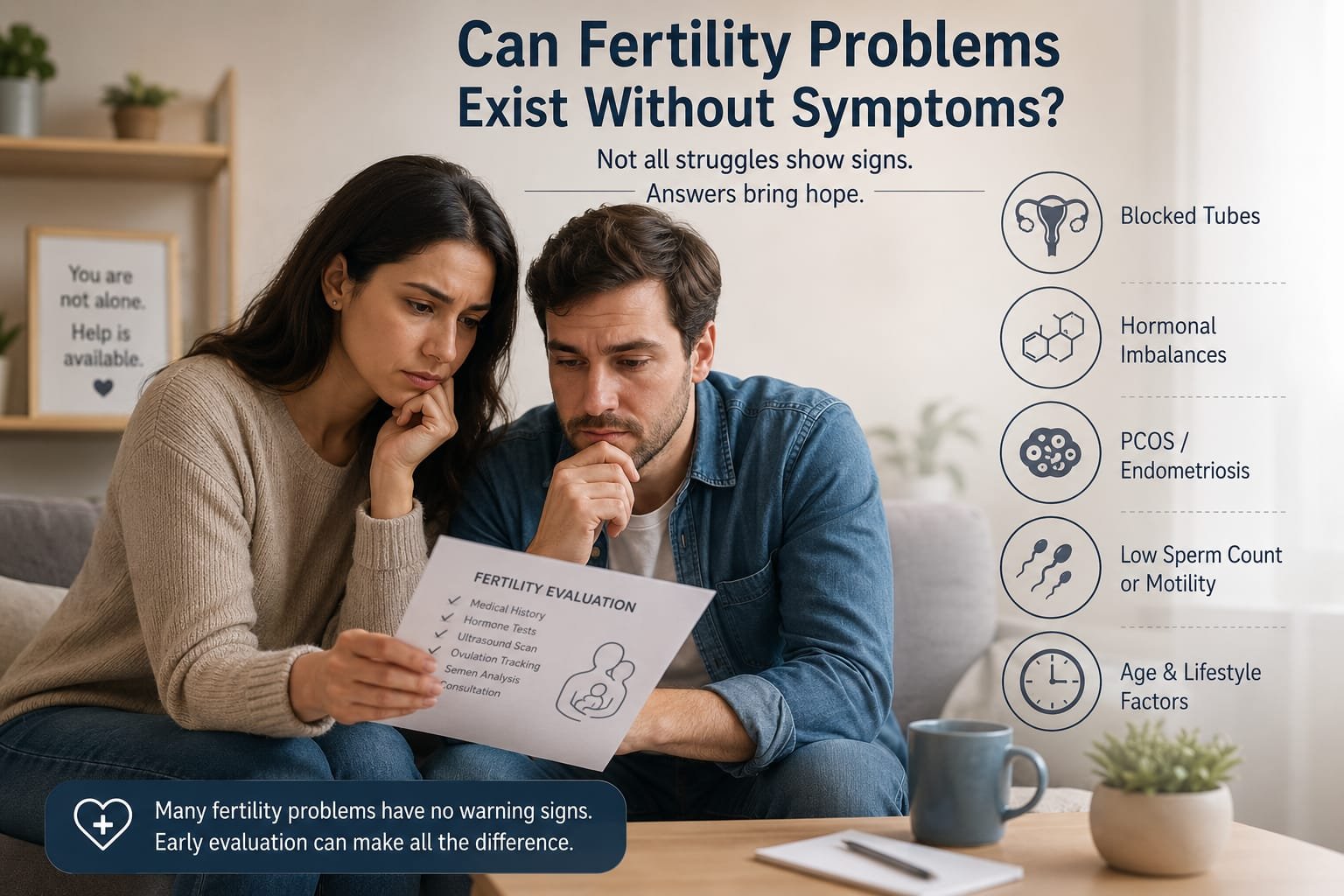
Infertility is something that will never manifest itself in any way, shape, or form. In fact, when you look at the most common causes of infertility in both men and women, all of them have a tendency to exist quietly for years. Discovered only after some deliberate effort, people can live their entire lives having regular menstrual cycles despite ovulation problems. They may even have blocked fallopian tubes and never experience any form of pain. Some women with polycystic ovary syndrome have irregular periods and acne, while others only discover the condition during fertility tests. Similarly, endometriosis can sometimes cause severe pain, but it can also be present with very few symptoms while still affecting your fertility.
In a way, your age is a stealthy problem as well, as fertility naturally takes a hit over time. This decline tends to occur gradually, without producing any obvious symptoms. You can still continue to have regular cycles even if your egg quantity and quality decline over time. Men, too, can very easily have reduced sperm count or poor sperm movement without any noticeable physical symptoms at all. Although low sperm production and abnormal sperm shape can also produce no outward-facing signs that people can easily detect, you can extend this to even your libido. People with normal sexual function can still experience difficulties contributing to pregnancy.
When should you be concerned about your fertility problems?
The general guidelines say that most people conceive naturally within a year of regular, unprotected intercourse if the female partner is under the age of 35. For women 35 years old, that timeline comes down to about six months because fertility declines with age. If your pregnancy did not occur during this period, it is best to start consulting a doctor to see what’s wrong.
Outside of this, there are a few more situations that do justify earlier assessments regardless of symptoms. Previous pelvic infections, chemotherapy, surgery involving the reproductive organs, non-hormonal disorders, repeated miscarriages, and a history of undescended testes in men can all create fertility challenges for couples. That last bit is super important, as male factors contribute to a substantial proportion of infertility cases, and most couples actually experience a combination of both male and female factors. There are also situations where, despite extensive investigations, no clear cause is identified. This is known as unexplained infertility, and it is also the reason why doctors generally recommend evaluating both partners together rather than focusing on only one person.
How are your fertility levels evaluated
The diagnosis for fertility problems generally relies on a series of tests, but before that, you usually have a discussion with your doctor first. One that covers topics such as your medical history, menstrual patterns, previous pregnancies, medications, lifestyle habits, and family history. As for the tests, for women, it is generally a mix of blood tests to assess hormone levels, ultrasound scans to examine the ovaries and uterus, and a couple of additional procedures to check whether the fallopian tubes are open. Across one or more menstrual cycles, your doctor may also monitor your ovulation pattern. On the men’s side, a semen analysis is often the only investigation that happens in this stage, as it is enough to provide information about sperm count, motility, and shape. Depending on its results, the doctor may order a couple more hormone tests or imaging studies.
With all that out of the way, one thing you should keep in mind is that a fertility test is not reserved for people who have already tried unsuccessfully for years or people who are actively trying. In some situations, this early assessment can provide significant reassurance and identify problems before time is lost. Not only that, but you also have a broader range of treatment options. Another thing that’s worth noting is that an abnormal result does not mean that pregnancy is simply a no-go for you and your partner. Thanks to modern advancements in medicine, most fertility issues out there are now treatable through medication, lifestyle adjustments, surgery, or assisted reproductive technologies. As long as you and your doctor can understand what’s causing the issue with these tests, you’ll be able to determine the best path forward – one that leads you to your fertility goals.
Should you focus solely on your fertility symptoms or look beyond them?
If there is one thing the discussion above has established, it is that, yes, modern medicine has improved our understanding of fertility, but it has also exposed just how misleading a person’s symptoms can be. You could be experiencing something like severe menstrual pain while, at the same time, carrying a higher chance of conceiving compared to someone in a similar situation. Your lifestyle also matters here, of course. Smoking, excessive alcohol consumption, obesity, being underweight, unmanaged chronic illnesses, and exposure to environmental toxins will all influence your fertility negatively.
The point is, fertility is something that is influenced by a lot of interconnected things, and no single symptom or lack of symptoms can accurately paint a picture of your reproductive health. As such, it is important that you don’t fall into the trap of self-diagnosing or diagnosing your partner based on half-baked research found on the internet or by comparing experiences with friends. Everyone’s journey is unique, and only your fertility test and your discussion with a doctor can reveal what is actually going on.
Sign up for a fertility test right away
Most of you out there will probably only discover an underlying issue when actually trying to conceive, even if you felt perfectly healthy. Yes, fertility problems can absolutely exist without symptoms. It’s also the reason why, conversely, the severe pain, irregular periods, or other obvious signs should not be taken as proof of unhealthy fertility. Keeping these two perspectives in mind, perhaps the best thing that you can do for yourself is to start your journey by speaking with a healthcare professional. An early evaluation from them will go a long way toward providing you with the answers you need, identifying any treatable conditions, and, most importantly, helping you make informed decisions for the journey ahead. So rather than shooting arrows in the dark and wondering what’s wrong, sign up for a test right away and take the first step towards achieving your fertility-related goals.
