
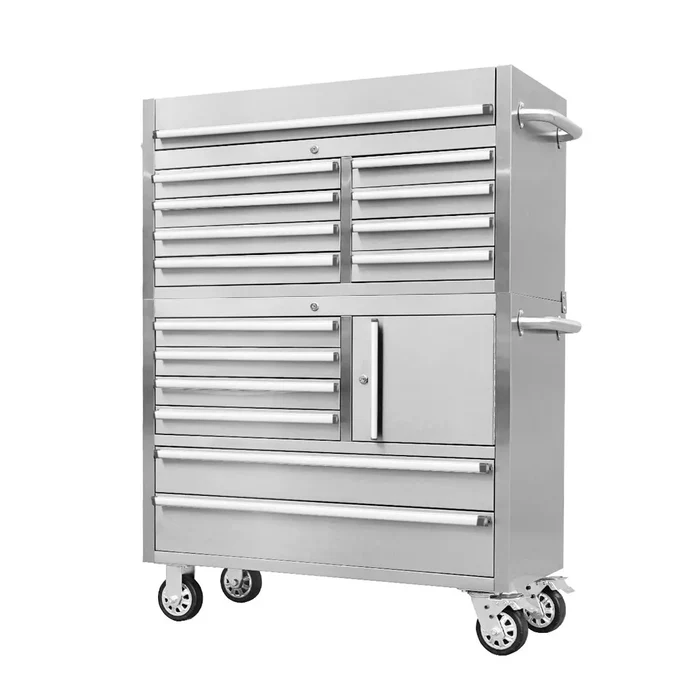
Late July is a punishing month for storage in a Canadian shop. Humid air drifts through open bay doors all afternoon and condenses on cool metal every morning, and the winter that follows arrives on the underside of every vehicle as brine and grit. A stainless steel tool chest stands through both while holding several hundred pounds of hand tools and absorbing knocks from carts, pallet jacks, and elbows.
Storage of that kind is structural equipment, not furniture. Every drawer full of sockets is a load that must travel somewhere, and the cabinet is a small frame resolving those loads into the floor.
A loaded drawer is a cantilever, and the slide is its bearing
Consider one drawer pulled halfway out. The tools inside press down on the drawer bottom, the bottom passes that force into the drawer sides, and the drawer sides hand it to the slide members bolted to the cabinet wall.
Ball bearing slides make that handoff through hardened steel balls rolling in raceways. Rolling contact replaces the sliding friction of a plain runner, which is why a drawer holding a hundred pounds of wrenches still opens under one finger.
The interesting part is where the force finally ends up. Each slide is a short cantilever anchored to the side panel, so a loaded drawer applies both a downward force and a twisting couple to that panel. Side panels therefore need stiffness for a reason that has nothing to do with holding tools and everything to do with keeping the two slides of a pair parallel.
When a panel flexes, those slides stop being parallel, the balls begin to bind, and the drawer drags. Most of the difference between a stainless steel tool chest that feels solid and one that feels cheap is panel stiffness rather than drawer thickness.
Every pen drawer walks the center of gravity forward
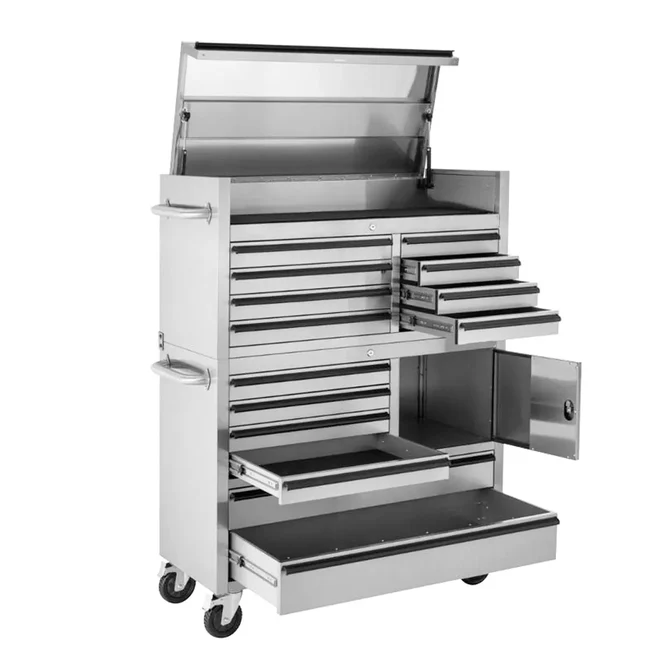
Step back and look at the whole cabinet. A stainless steel tool chest on casters is a tall box balanced over a rectangle drawn between four wheel contact points, and it stays upright only while the combined center of gravity of shell and contents falls inside that rectangle.
Pull a full drawer to its stops and a substantial mass travels forward, often past the front face of the cabinet. That creates a tipping moment: the weight multiplied by how far it has moved ahead of the front wheels.
Working against it is the restoring moment of everything still inside, each item multiplied by its own distance behind that wheel line. Stability is the contest between those numbers.
This turns loading order into a safety decision. Heavy sockets, pullers, and torque wrenches belong in the lowest drawers, where they contribute restoring weight low and close to the base; light items belong higher up.
The same arithmetic explains the drawer interlock. If two or three fully loaded drawers can stand open at once, their forward moments add together, and a cabinet that was comfortably stable with one drawer open may not be with three.
An interlock allows one drawer at a time, placing a hard ceiling on the worst tipping moment the cabinet can produce. A technician in a Winnipeg fleet garage who rolls a chest across an expansion joint with a drawer extended learns the point quickly.
Stainless heals its own surface; paint has no such option
Corrosion is a separate kind of engineering, and it is where a stainless steel tool chest earns its price in this climate.
A painted cabinet relies on a barrier. The film keeps moisture and chloride away from the iron beneath, and while the film is unbroken the steel underneath is genuinely safe. Shops, however, are full of things that break films: dropped ratchets, cart corners, welding spatter.
Once a scratch reaches bare metal the damage refuses to stay in the scratch. Moisture settles in the groove, the exposed iron becomes an anode while the surrounding coated area behaves as a cathode, and rust creeps sideways beneath the paint, lifting more film as it grows.
Stainless steel works on the opposite principle. Chromium in the alloy reacts with oxygen in the air to build an extremely thin, tightly bonded chromium oxide layer, the passive film. Scratch it and fresh chromium meets the air and rebuilds the film within moments.
Protection is regenerated rather than spent, which is the whole argument. Chlorides are the one common agent that can break a passive film down locally and start pitting, so road salt tracked indoors in February still deserves a wipe with clean water, but a painted chest in the same bay is already blooming rust at every chip.
Sorting tool storage by where the structural work happens
Catalogs usually sort storage by size, which tells a buyer very little. A more useful classification asks where the structure actually carries the load, because that determines what gives way when the equipment is overloaded.
•Fixed workbench: load carried by top frame and legs
•Rolling cabinet: load carried by body shell and casters
•Portable box: load carried by handle and outer shell
A fixed bench takes weight through its top frame and legs straight into the floor, so its limit is a bending limit at the top. A rolling cabinet has no legs at all: the body shell itself acts as the beam, and everything funnels into four small caster mounts.
A portable box carries the entire contents through its handle and the walls hanging from it, which is why an overfilled box tears at the handle rather than sagging in the middle. Knowing which member does the work tells an owner where cracks will appear.
Many drawers is a stiffness question, not only an organizing one
A forty-one-inch stainless steel tool chest divided into fourteen drawers is not one large cabinet scaled down. Every drawer opening removes material from the front face, and the front face is a large part of what keeps the box square.
The remaining structure has to take over that duty: the horizontal rails between drawer openings and the rear panel behind them. A rear panel acts as a shear web, resisting the racking that would otherwise fold a rectangular cabinet into a parallelogram when it is shoved sideways across a floor.
Splitting the available height into more and shorter openings leaves extra rail material between them, so a heavily divided chest often feels more rigid than the same shell carrying three tall drawers.
Read as a structure, the cabinet is a stack of small cantilevers hung from two stiff side panels, balanced over a caster rectangle that one open drawer can threaten, and wrapped in an alloy that repairs its own surface faster than a working shop can scratch it. Load the heavy tools low, close the drawers before rolling, rinse the winter chlorides away, and a stainless steel tool chest will comfortably outlast several generations of the tools kept inside it.
