
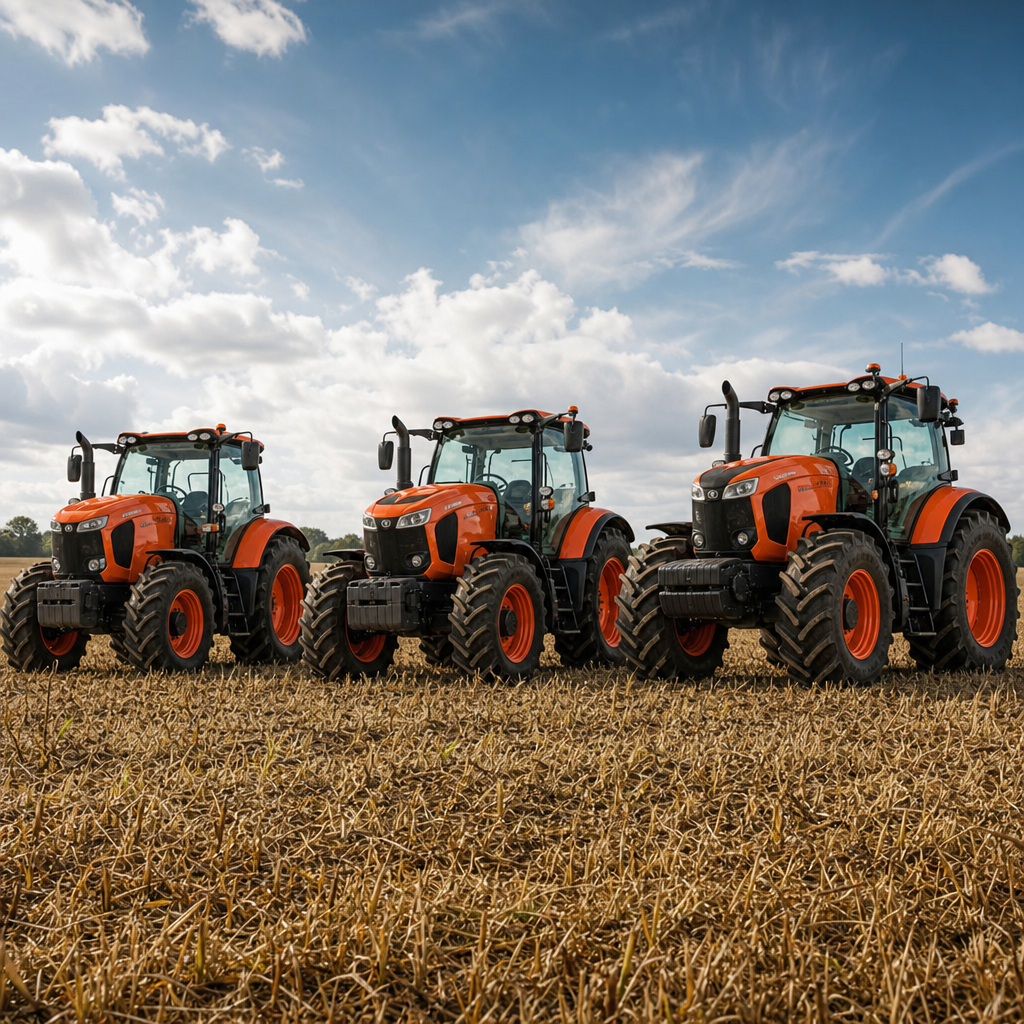
Why Choosing the Right Tractor Matters More Than Ever
Farming has always demanded precision — not just in the field, but in the equipment room. The tractor you select will define your productivity, your fuel costs, your maintenance schedule, and ultimately your bottom line for years to come. With so many models available from leading manufacturers, it can be genuinely difficult to cut through the marketing noise and identify which machine is truly built for your land, your crops, and your workload. Kubota, one of the most trusted names in agricultural machinery, offers a range of tractors that cater to vastly different operational needs. Understanding the distinctions between their popular series is not just helpful — it is essential before committing to a significant capital investment.
Understanding the Kubota M-Series: Versatility for Mid-Scale Operations
The Kubota M-Series has long been a workhorse for mid-scale farmers, livestock operators, and those managing mixed-use land. These tractors are designed to handle a broad spectrum of tasks — from loader work and hay production to light tillage and property maintenance. Their engine outputs typically range from around 85 to 135 horsepower, placing them firmly in the utility tractor category. What makes the M-Series particularly appealing is its balance between capability and cost. Operators who need a reliable, multi-purpose machine without the premium price tag of a larger row-crop tractor often find the M-Series to be an ideal fit. The cab comfort, hydraulic performance, and transmission options have all been refined over successive generations, making these tractors genuinely competitive in their segment.
Key Strengths of the M-Series Platform
The M-Series shines in environments where flexibility is paramount. Whether you are running a front-end loader for barn chores in the morning and switching to a rotary cutter in the afternoon, these tractors transition smoothly between implements. The hydraulic flow rates are sufficient for most mid-duty attachments, and the PTO options — both rear and mid — give operators the versatility they need across seasons. Fuel efficiency is another area where the M-Series earns consistent praise, particularly during lighter-duty tasks where the engine does not need to work at full capacity.
Stepping Up: The Kubota M7 Series and Its Purpose-Built Design
The Kubota M7 represents a meaningful step up in both power and sophistication. Designed with larger-scale arable and livestock operations in mind, the M7 series delivers horsepower figures ranging from approximately 130 to 175 HP, depending on the specific model. More importantly, the M7 is engineered for high-intensity field work — extended hours of tillage, planting, and harvesting support — where durability and consistent performance under load are non-negotiable. The cab environment in the M7 is noticeably more refined than the standard M-Series, with improved ergonomics, enhanced visibility, and a more intuitive operator interface. For farmers who spend long days in the seat, these details are not luxuries — they are productivity tools.
Transmission and Technology in the M7
One of the defining features of the M7 is its transmission technology. The available powershift and continuously variable transmission (CVT) options allow operators to maintain optimal ground speed and engine efficiency across varying field conditions. This is particularly valuable during operations like spraying or seeding, where consistent speed directly affects application accuracy. The M7 also integrates more advanced precision agriculture compatibility, making it a strong candidate for farms that are beginning to adopt GPS-guided field management systems.
The Kubota M8: Premium Power for Demanding Row-Crop Farming
At the top of Kubota’s conventional tractor lineup sits the M8 series — a machine built specifically to compete in the high-horsepower row-crop segment. With power outputs reaching up to 235 HP, the M8 is designed for large-scale grain and row-crop operations where pulling power, field efficiency, and technology integration are the primary concerns. The M8 features a purpose-built row-crop chassis with narrow front axle options, improved ground clearance, and a cab that rivals anything in its class for operator comfort and visibility. It is, in every meaningful sense, a professional-grade machine for professional-scale farming.
When the M8 Makes Financial Sense
Investing in an M8 is a decision that requires honest assessment of your operation’s scale. If you are farming several hundred acres of row crops, managing large-scale tillage programs, or running high-capacity planting and harvesting equipment, the M8’s power and efficiency gains will justify the higher acquisition cost over time. For smaller operations, however, the M8 may represent more machine than the workload demands — and the ongoing operating costs could outpace the productivity benefits. This is precisely why a structured comparison is so valuable before making a purchase decision.
Making an Informed Decision: The Value of Side-by-Side Analysis
A thorough Kubota tractor comparison across the M-Series, M7, and M8 platforms reveals that each machine occupies a distinct and well-defined role in the agricultural equipment landscape. The M-Series serves the versatile mid-scale operator, the M7 bridges the gap for serious arable farmers, and the M8 delivers elite performance for large-scale row-crop production. Understanding where your operation falls within that spectrum — and being honest about your current and future needs — is the foundation of a sound equipment investment.
Walk-Behind Tractors: An Alternative Worth Considering for Smaller Plots
Not every farming operation requires a full-size tractor. For market gardeners, smallholders, and those managing compact vegetable plots, walk-behind tractors offer a cost-effective and highly maneuverable alternative. These machines can handle tillage, hilling, and cultivation in tight spaces where a conventional tractor would be impractical. If you are exploring lower-cost entry points into mechanized farming, this detailed guide on walk-behind tractors as a low-cost farming solution provides an excellent overview of their practical applications and limitations.
About HRAGripower: Trusted Agricultural Expertise
HRAGripower has established itself as a credible voice in the agricultural equipment space, offering farmers and landowners detailed, unbiased guidance on machinery selection, maintenance, and operational best practices. Their content is grounded in real-world farming experience and a genuine understanding of how equipment decisions affect long-term farm profitability. Whether you are a first-time tractor buyer or an experienced operator looking to upgrade, their resources are designed to help you make confident, well-informed choices without the pressure of a sales environment.
Evaluating Equipment Reviews Before You Buy
Beyond manufacturer specifications and dealer conversations, independent equipment reviews play a crucial role in the buying process. Real-world feedback from operators who have put machines through demanding conditions provides insight that brochures simply cannot offer. Before finalizing any major equipment purchase, it is worth consulting a range of sources — including verified reviews of agricultural equipment retailers — to understand not just how a machine performs, but how the purchasing and support experience measures up to expectations.
Conclusion: Match the Machine to the Mission
The Kubota M-Series, M7, and M8 are all exceptional tractors within their respective categories. The critical variable is not which machine is objectively best — it is which machine is best suited to your specific operation, your land, your implements, and your long-term farming goals. Take the time to assess your average daily workload, your peak seasonal demands, and your five-year growth trajectory before committing. Speak with operators who use the machines you are considering, consult independent reviews, and leverage the detailed comparison resources available from trusted agricultural content providers. The right tractor is not the most powerful one on the lot — it is the one that works hardest for your farm, every single day.
