
For decades, solar adoption has been constrained not by energy availability but by hardware compatibility. Glass-encapsulated rigid panels – the dominant form factor across residential, commercial, and industrial installations – operate on a set of structural assumptions: flat surfaces, load-bearing rooftops, permanent mounting infrastructure, and environments where mechanical stability is guaranteed. When any of those conditions are absent, the installation either becomes cost-prohibitive or structurally impossible.
That constraint has excluded an enormous range of surfaces from solar viability – curved roofs, lightweight structures, mobile platforms, ageing buildings, and complex architectural geometries. Flexible photovoltaic panels emerge directly from this gap, engineered not as a variation on conventional technology but as a fundamentally different approach to how and where solar energy can be captured.
What They Are and What Separates Them From Alternatives
A flexible photovoltaic panel is a solar energy device built on substrates that allow the panel to bend, conform, and adhere to non-planar surfaces without fracture or performance loss. Unlike glass panels, which rely on rigid silicon wafers laminated beneath tempered glass, flexible PV systems use proprietary polymer-based cell architectures that eliminate glass and brittle wafer construction entirely.
This distinction matters in practice. Semi-flexible panels, often marketed as an intermediate solution, retain crystalline silicon wafer cells within a softened encapsulation. The polymer casing reduces overall rigidity, but the underlying silicon remains susceptible to microcracking under sustained mechanical stress, vibration, or repeated thermal cycling. Performance degradation in semi-flexible systems, though gradual, accumulates in precisely the environments – vehicles, curved structures, high-vibration industrial settings – where they are most frequently deployed.
Fully flexible photovoltaic systems replace the silicon wafer cell with a patented flexible cell structure, removing the fracture risk at the fundamental component level. The encapsulating polymer substrate is not simply a softer wrapper around a rigid core – it is an integral part of a system designed from the outset for mechanical adaptability. Panels built on this architecture can conform to curved and irregular surfaces, absorb impact and vibration without initiating micro-fracture, and adhere directly to substrates without requiring racking, drilling, or structural reinforcement.
The Applications They Unlock
The transformative impact of fully flexible photovoltaic technology is most apparent in the categories of deployment that glass-based systems cannot reach.
Commercial and Industrial Rooftops with Load Restrictions
A substantial share of commercial building stock globally, including logistics warehouses, manufacturing facilities, greenhouses, stadiums, and older institutional structures, cannot support the dead load of conventional glass panel arrays and their associated racking. Flexible panels, bonded adhesively across the roof surface, distribute their minimal weight evenly and eliminate the structural engineering requirement that otherwise precedes installation. Buildings previously excluded from solar adoption enter the deployable inventory.
Curved and Non-Standard Architectural Surfaces
Arched rooftops, polycarbonate canopies, and complex building geometries that defeat rigid panel layouts are fully compatible with flexible PV. The panel conforms to the surface geometry rather than requiring the surface to approximate a flat plane. This compatibility extends solar energy generation into architectural contexts where it has historically been impractical.
Mobile and Vehicular Platforms
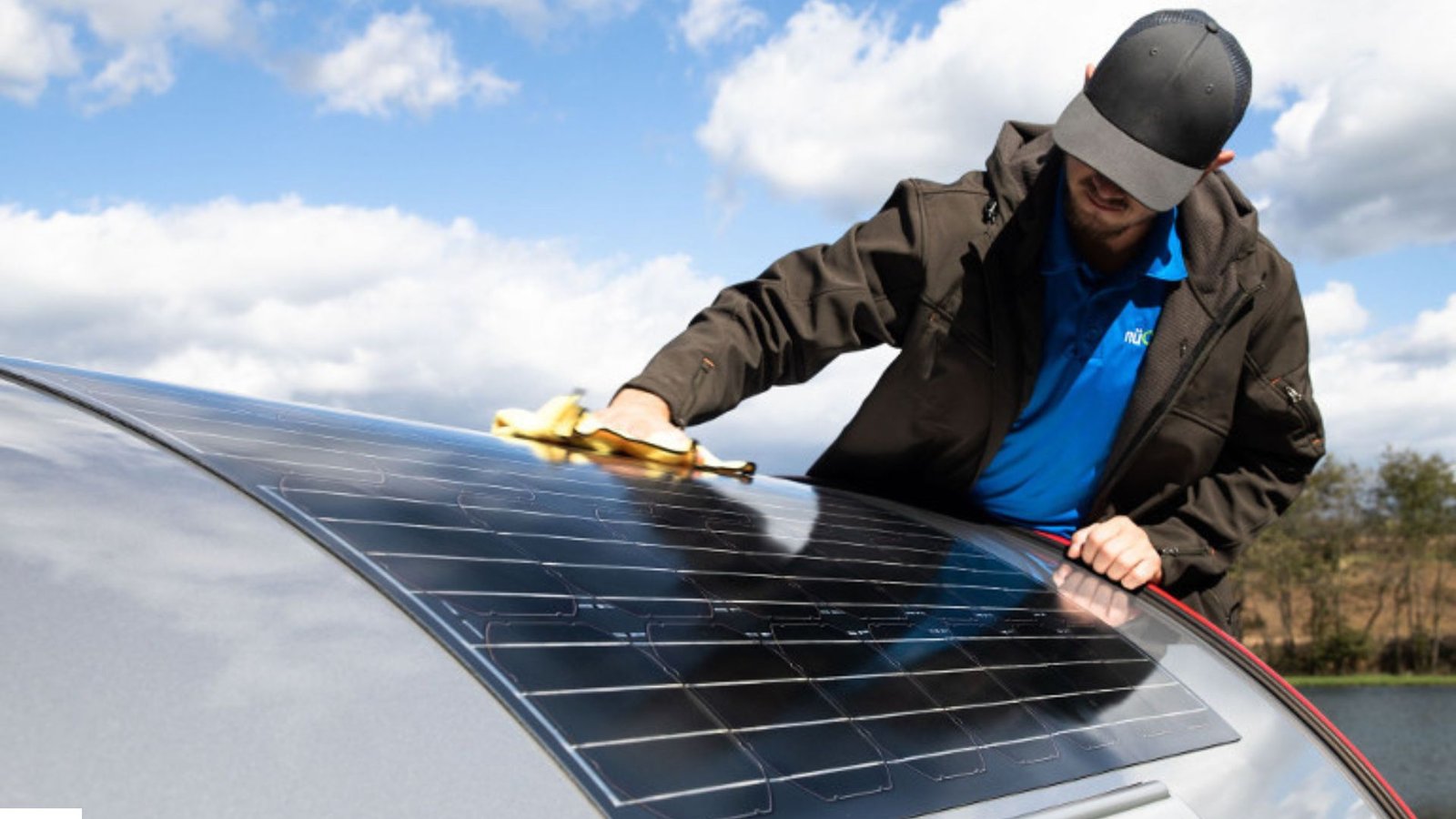
Flexible photovoltaic systems used as car solar panels are increasingly being deployed in vehicle-based energy solutions where roof curvature and vibration make traditional systems impractical. Flexible photovoltaic panels conform to curved vehicle rooftops without penetrating the roof membrane, adding minimal weight, and sustaining performance across the vibration and thermal stress profiles of road operation. The same technology integrates into retractable awning structures, expanding solar capture surface area beyond what the rooftop alone can accommodate.
Embedded and Integrated Applications
Because flexible PV cells are rollable and shapeable, they can be incorporated directly into materials, awning fabrics, architectural membranes, and vehicle body panels, rather than mounted on top of them. This integration capability opens a category of solar deployment that is invisible in the conventional sense, energy generating surfaces that serve primary structural or functional roles without any dedicated panel footprint.
FAQs
How do fully flexible panels perform compared to glass panels in terms of energy output?
Fully flexible photovoltaic systems deliver efficiency levels broadly comparable to standard monocrystalline glass panels. The cell architecture, not the encapsulation material, primarily determines conversion efficiency. Decision makers should size systems based on available surface area and energy demand rather than assuming a material based efficiency penalty.
Are adhesive mounted flexible panels permanent, and can they be removed or relocated?
Adhesive bonded flexible panel systems are designed for long term durability but can be removed and reinstalled with less structural disruption than mechanically fastened systems. This is useful for phased refurbishment projects or fleet based applications where asset relocation is required.
What maintenance does a flexible photovoltaic system require compared to conventional panels?
Flexible systems are designed for low maintenance operation. The absence of glass reduces breakage risk and improves durability in vibration heavy environments. Routine surface cleaning is generally the primary maintenance requirement to maintain optimal performance.
