
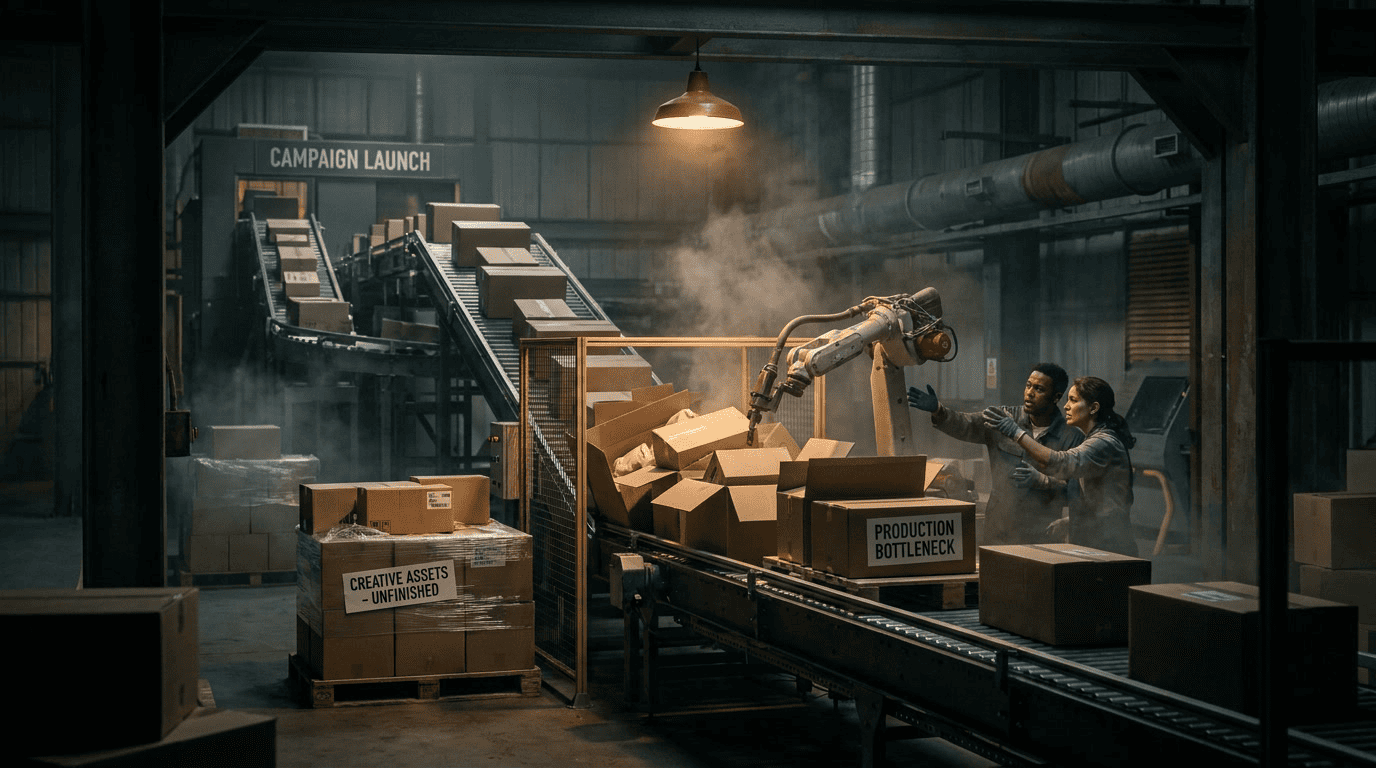
The modern digital landscape moves faster than most creative teams can manage. When a marketing campaign shows signs of success, the immediate instinct is to scale the budget. However, budget is rarely the factor that stops growth in its tracks. The real culprit is almost always a creative production bottleneck.
Scaling requires a constant stream of fresh visual content to combat creative fatigue. When your team cannot produce high-quality videos fast enough, your performance metrics begin to suffer. This phenomenon is why many brands fail to move from small-scale testing to massive market penetration.
The Invisible Ceiling of Creative Scaling
Creative production has traditionally been a linear, labor-intensive process. You need scripts, actors, sets, editors, and sound engineers. Each of these components adds time and cost to the workflow. If you want to test ten different versions of an ad, you often have to film ten different scenes.
This linear approach creates a ceiling for your growth. Even with a massive budget, you are limited by the physical hours required to edit and render footage. Most teams find that as they scale, their cost per acquisition rises because they cannot refresh their creatives fast enough to keep audiences engaged.
High-performance marketing thrives on iteration. You need to see what works, why it works, and how to replicate it across different demographics. Without an efficient ai ad generator to handle the heavy lifting, your team stays stuck in the production phase instead of the strategy phase.
Why Quality and Speed Often Conflict
In the past, brands had to choose between speed and quality. You could produce “lo-fi” content quickly, but it often lacked the brand authority needed for high-ticket conversions. Conversely, high-end cinematic content took weeks or months to finalize.
This conflict is the primary reason for campaign stagnation. If you wait three weeks for a polished video, the market trend might have already passed. If you post low-quality content, you risk damaging your brand reputation. This dilemma is exactly what a modern ai ad generator solves by combining professional aesthetics with instant output.
According to research by Nielsen Research, creativity is the most important driver of advertising effectiveness. It contributes more to sales lift than reach or targeting. When production bottlenecks slow down your creative output, they are directly impacting your bottom line.
Introducing Seedance 2.0: The Technology of Transformation
To solve these bottlenecks, ByteDance developed Seedance 2.0. This is a state-of-the-art AI video generation model designed for professional-grade output. It represents a massive leap forward in how video content is conceptualized and executed.
Seedance 2.0 is not just a simple text-to-video tool. It is a multi-modal powerhouse that accepts up to 12 different assets as inputs. This includes:
- Text prompts for conceptual direction.
- Static images for visual reference.
- Existing video clips for style or motion transfer.
- Audio files for native synchronization.
Because higgsfield provides access to this model on all subscription plans, professional video creation is now democratized. You no longer need a massive studio to produce cinematic, multi-shot videos.
Achieving Character Consistency and Precision
One of the biggest hurdles in AI video has been consistency. In earlier models, a character might look different from one frame to the next. This made it impossible to use AI for professional storytelling or brand-driven ads.
Seedance 2.0 solves this through frame-level precision and advanced character consistency. You can maintain the same “look” across multiple shots, which is essential for building a brand identity. Higgsfield enables users to harness this power to create complex narratives that feel cohesive and professional.
Furthermore, the model handles native audio sync. This means your characters’ mouth movements align with the audio inputs. This level of detail used to require expensive post-production software and hours of manual labor. Now, it happens as part of the generation process within an ai ad generator workflow.
Strategy: How to Use AI Video to Break Bottlenecks
To scale your campaigns effectively, you must change how you think about production. Instead of viewing every video as a standalone project, view them as iterations of a core concept. Here are four strategies to implement today:
- The Asset-First Approach: Use your existing product photos and brand colors as inputs. Let the AI generate 10 variations based on different hooks.
- UGC to CGI Transition: Take simple user-generated content and use it as a reference video. The AI can then transform that raw footage into a polished, high-end commercial.
- Multi-Format Deployment: Generate content for 9 different ad formats simultaneously. Whether it is a vertical TikTok or a horizontal YouTube ad, the AI handles the resizing and composition.
- Rapid A/B Testing: Instead of testing two ads, test twenty. Change the background, the avatar, or the lighting in seconds to find the winning combination.
By using an ai ad generator, you are no longer paying for the time of an editor. You are paying for the creativity of your strategy. This allows higgsfield users to focus on what actually moves the needle: the message and the offer.
Reducing the Cost of Failure
In traditional production, a “failed” ad is a financial disaster. If you spend $5,000 on a video that doesn’t convert, that money is gone. This fear of failure often leads to conservative creative choices, which results in boring ads.
AI video generation changes the math. Because the cost of production is so low, the cost of failure is negligible. You can afford to be bold. You can afford to test “weird” ideas that might just become your best-performing assets.
Higgsfield empowers marketing teams to take these risks. When you can turn a product URL into a scroll-stopping video in minutes, you gain the freedom to experiment. This experimentation is the key to discovering the “unicorn” ads that allow you to scale your budget 10x or 100x.
Solving the Localization Problem
For global brands, localization is a massive bottleneck. Translating text is easy, but re-shooting videos for different cultures is incredibly expensive. Scaling globally usually requires a massive production overhead.
With the right ai ad generator, localization becomes a software task rather than a production task. You can swap out avatars to match local demographics. You can sync new audio in different languages. You can even change the background elements to better suit a specific region.
This capability is a core feature for teams using higgsfield. It allows a small team to manage global campaigns that previously required dozens of local agencies. By removing the physical barriers to content creation, you remove the barriers to global growth.
The Role of Virtual Try-Ons and Avatars
In e-commerce, the “bridge of trust” is the biggest hurdle. Customers want to see how a product looks and moves. Traditional product demos are static and often fail to capture the imagination.
Modern AI models offer virtual try-ons and over 40 AI avatars. These tools allow you to show your product in action without hiring a single model. You can create a digital person who represents your target audience perfectly.
Using an ai ad generator to create these demos ensures that your production remains consistent. You can use the same avatar for your brand’s entire lifecycle. This creates a familiar face for your customers, building brand equity over time.
Integrating AI into Your Existing Workflow
Switching to AI-driven production does not mean firing your creative team. Instead, it means augmenting them. Your designers and copywriters become “AI Orchestrators.” They provide the vision, and tools like higgsfield provide the execution.
A successful integration looks like this:
- Phase 1: Your team identifies a high-performing product link.
- Phase 2: They use an ai ad generator to produce five different visual styles.
- Phase 3: The best-performing style is then expanded into a full campaign using Seedance 2.0’s multi-shot capabilities.
- Phase 4: Feedback from the live ads is fed back into the next round of prompts.
This loop is significantly faster than any traditional agency workflow. It allows you to respond to market changes in real-time. If a competitor launches a new sale, you can have a counter-ad live within the hour.
Conclusion: Scaling Without the Stress
Creative production bottlenecks are a choice, not a necessity. The technology now exists to produce cinematic, high-converting video at scale. By leveraging models like Seedance 2.0, brands can finally align their creative output with their media spend.
The future of marketing belongs to those who can produce the most value in the shortest amount of time. Using an ai ad generator is the only way to stay competitive in an environment where content is consumed at an infinite rate.
Stop letting your production schedule dictate your growth. With higgsfield, you have the tools to break through the bottlenecks and reach the full potential of your campaigns. The only limit left is your imagination.
