
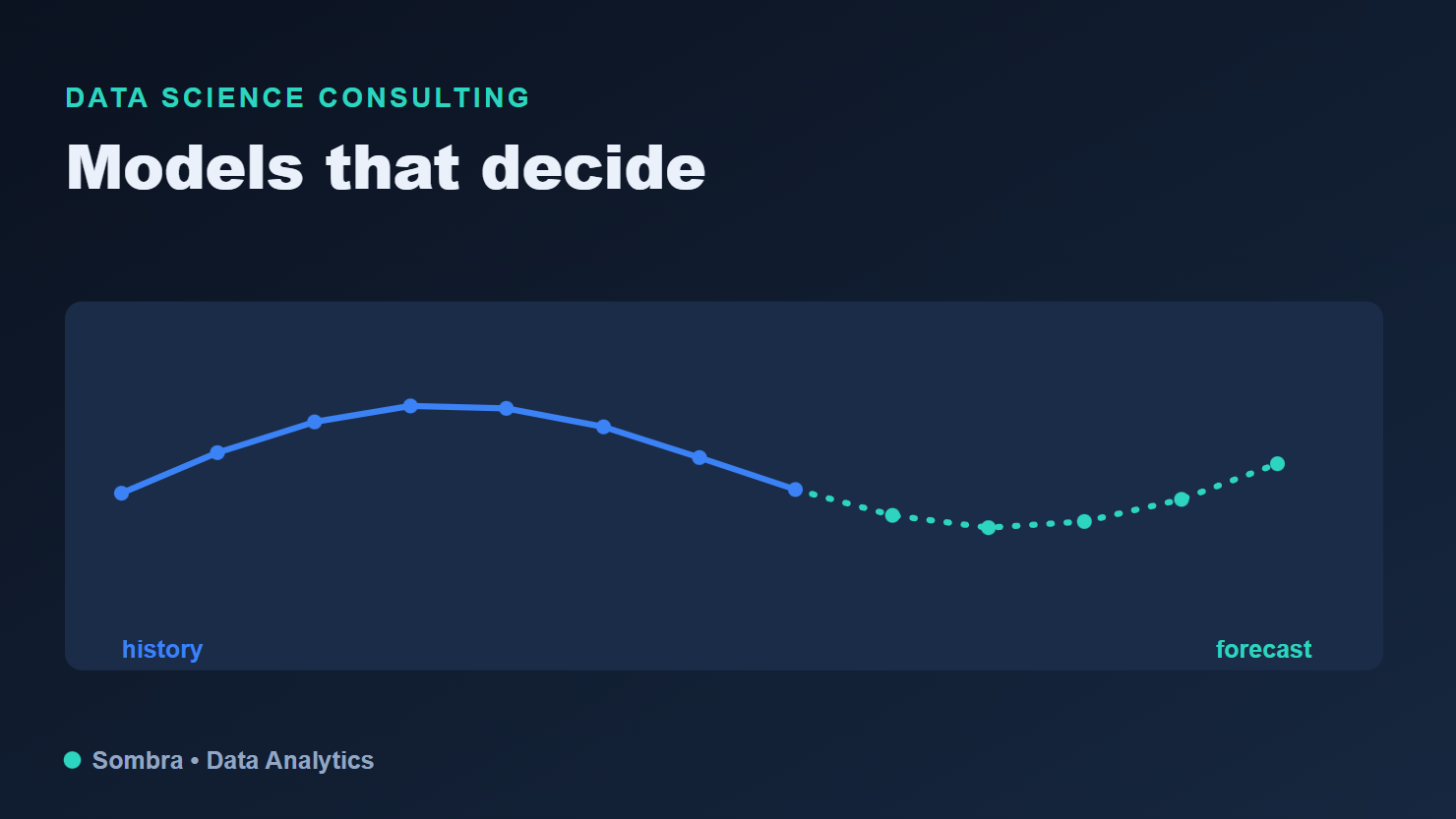
Most companies don’t have a data problem. They have a data management problem. The numbers exist, they’re just scattered across a CRM, three spreadsheets, a billing system and someone’s laptop. Data management services exist to fix exactly that: to take the raw, messy, duplicated information a business already collects and turn it into something people can actually trust and use.
If you’ve ever pulled two reports that disagreed on last quarter’s revenue, you already understand why this matters. And it isn’t a cheap problem to ignore — Gartner estimates that poor data quality costs the average organization around $12.9 million a year in wasted effort, bad decisions and missed opportunities.
Diagram showing scattered business data being unified through data management services
Caption: Data management services consolidate siloed sources into a single trusted layer.
What data management services actually include
The term gets thrown around loosely, so let’s be specific. A complete data management offering usually covers a handful of connected disciplines:
- Data strategy and assessment. Before anyone moves a single record, a good partner audits what you have, where it lives and how reliable it is. This step is boring and unglamorous and skipping it is the single most common reason data projects fail.
- Data quality and validation. Deduplication, standardizing formats, catching the customer who appears four times under slightly different spellings. Clean inputs are the whole game and the downstream cost of skipping this shows up everywhere from marketing spend to compliance.
- Data integration and unification. Connecting siloed systems so one source feeds another instead of each team maintaining its own version of the truth.
- Storage and architecture. Choosing where data lives — a warehouse like Snowflake or BigQuery, a lakehouse on Databricks — and structuring it so it scales without falling over.
- Governance and security. Who can see what, how access is logged and how you stay compliant with regulations like GDPR or HIPAA.
You rarely need all of these at once. But you do need a partner who understands how they fit together, because fixing one in isolation tends to break another.
Signs you’ve outgrown spreadsheets
There’s no universal trigger, but a few patterns show up again and again:
- Reports take days, not minutes. When pulling a routine number requires a person to manually stitch sources together, your reporting can’t keep pace with your decisions.
- Teams argue about whose numbers are right. Conflicting figures usually mean conflicting definitions and no single source of truth.
- You’re scaling and onboarding is painful. New tools, new regions or an acquisition multiply the number of systems that need to talk to each other.
- Compliance is becoming a real risk. Once regulators or enterprise customers start asking how you handle data, ad-hoc processes stop being acceptable.
If two or more of these sound familiar, you’re past the point where internal patchwork pays off.
Build internally or bring in a partner?
Hiring a full in-house data team is expensive and slow and for many mid-sized companies it’s overkill. The work is also lumpy — heavy during setup and migration, lighter during steady-state operation. That uneven workload is exactly why outside help makes sense for the build phase even when you keep operations internal.
A strong external team brings patterns it has seen across dozens of projects, which means fewer expensive mistakes. The right engagement model matters here too. Some companies want a project-based build and then take over; others prefer ongoing managed delivery or staff augmentation to fill specific gaps. A capable partner offers more than one option instead of forcing you into theirs.
This is where working with a dedicated data management and analytics services team pays off — you get the architecture, integration and governance work done by people who do it full-time, without carrying the headcount year-round.
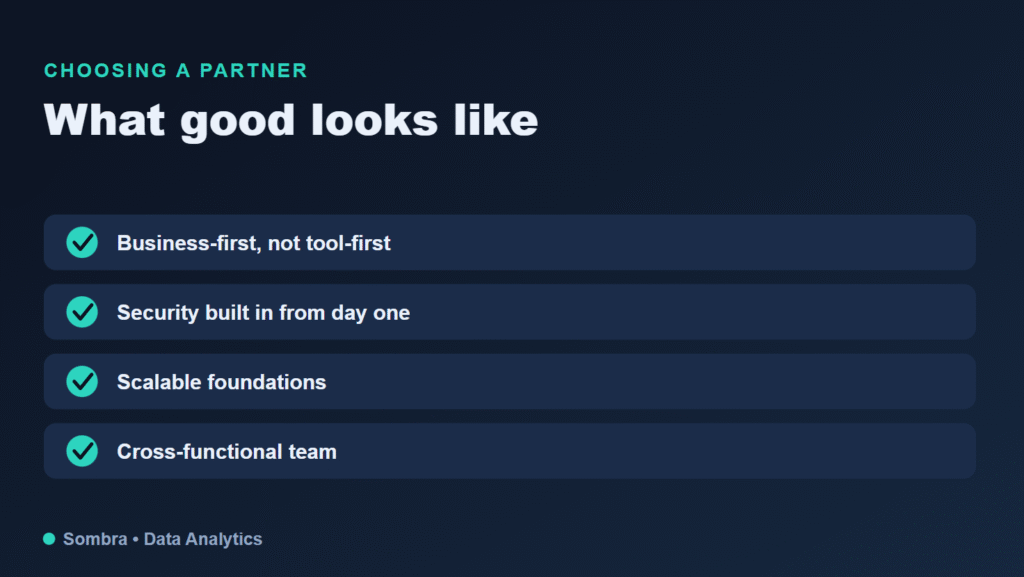
Checklist of qualities to look for when choosing a data management services partner
Caption: The traits that separate a reliable data management services partner from a risky one.
What good looks like
Not all providers are equal. A few things separate the ones worth hiring:
- Business-first, not tool-first. Beware anyone who leads with a specific platform before understanding your problem. The technology should follow the outcome, not the other way around. The best engagements start with “what decision are you trying to make faster?” rather than “let’s set up Databricks.”
- Security built in, not bolted on. Governance and access control should be part of the design from day one, not a phase you schedule for later and never reach.
- Scalable foundations over quick dashboards. A pretty report on a shaky foundation breaks the moment your data volume doubles. Solid pipelines and storage architecture are less visible but far more valuable.
- Cross-functional teams. Real data work needs engineers, analysts and people who understand your domain. A single specialist working alone tends to produce something technically correct and practically useless.
A realistic timeline
People often expect either instant results or an endless project. Reality sits in between. A typical engagement follows a sequence: strategic alignment, current-state assessment, solution design, implementation, deployment, then ongoing support and optimization.
The assessment and design phases feel slow because nothing visible is shipping, but they determine whether everything after them works. Most mid-sized initiatives show meaningful results within a few months — a unified reporting layer, clean customer data, automated pipelines replacing manual exports. Full maturity, where data quietly powers everyday decisions, takes longer and never really “finishes.” That’s fine. Data management is maintenance, not a one-time build.
The payoff
When data management is done right, you stop noticing it. Reports are simply correct. New systems connect without drama. Teams stop debating numbers and start acting on them. Analysts spend their time finding insights instead of cleaning files.
That quiet reliability is the goal. It’s also the foundation for everything more advanced — predictive analytics, machine learning, real-time reporting — none of which works on top of messy data.
If your organization is wrestling with scattered, untrustworthy information, the fix isn’t another tool. It’s a deliberate approach to managing the data you already have. Start with an honest assessment of your current state and build from there.
